
Newsletter Subscribe
Enter your email address below and subscribe to our newsletter

 ByJohn A
Managing a custom apparel project—whether for an indie clothing brand, a campus student club, or a corporate gifting suite—requires coordinating multiple production variables under strict budget caps. Creative leads often spend weeks perfecting digital artwork, Pantone swatches, and marketing campaigns while treating the base sweatshirt as a last-minute decision. Rushing blank selection frequently leads to disappointing surprises upon delivery, such as scratchy interiors, tight neck openings, or graphics that crack after the first wash.
Sourcing blank hoodies wholesale provides creative teams with factory-direct pricing, consistent sizing, and dependable knit surfaces engineered for commercial decoration. Approaching your order with a structured plan ensures your custom apparel project finishes on schedule, within budget, and at retail-grade quality.
The longevity and comfort of a custom sweatshirt depend directly on its yarn construction and fleece weight. When evaluating wholesale blank apparel, understanding raw textile properties helps you pick the right blank for your design and printing method.
Fleece weight is measured in ounces per square yard or grams per square meter. Lightweight fleeces (7.0 to 7.5 oz) are great for budget-conscious indoor events, while midweight fleeces (8.0 to 8.5 oz) provide the versatility and warmth needed for everyday lifestyle wear. Heavyweight fleeces (9.0 to 12.0 oz) deliver the thick, structured drape popular in modern premium streetwear.
Pay close attention to the outer face of the knit. Blanks made with 100% combed ring-spun cotton faces provide an ultra-smooth, flat surface that allows screen print inks and heat transfers to adhere cleanly without fabric fuzz poking through the design.
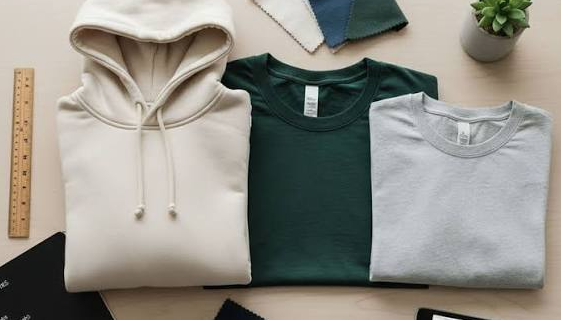
While monochrome neutrals like black and white remain essential staples, incorporating rich earthy tones brings depth and seasonal appeal to custom collections. Adding versatile green hoodies—ranging from deep forest and pine to soft sage and military olive—gives brands an approachable, nature-inspired palette that performs exceptionally well in autumn and winter releases.
Olive and forest greens pair naturally with earthy khakis, blue denim, and neutral outerwear, offering an understated alternative to stark black.
Including natural green colorways alongside core basics gives your collection a fresh, lifestyle-oriented feel that stands out in online lookbooks and retail displays.
Because hooded pullovers experience regular mechanical stress when pulled over the head and during physical activity, inspecting physical construction details is essential before ordering at volume.
High-caliber blanks feature double-needle stitching along the neck opening, armholes, pouch pocket corners, and waistband. Reinforced bar-tack stitching at the kangaroo pocket stress points prevents common tears caused by hands resting in the pocket or carrying heavy mobile devices.
A well-constructed three-piece jersey-lined hood lies flat against the upper back when down and contours comfortably around the head when worn, avoiding the stiff, awkward shape of unlined two-piece hoods.
Different customization methods require specific fabric properties to achieve sharp, durable results across a full production run.
Direct-to-film transfers have become a popular decorating choice. Selecting hoodies for DTF printing requires a smooth, tightly knit exterior so the hot-melt adhesive powder can bond securely into the fabric fibers without lifting around the edges.
Traditional screen printing with water-based discharge inks requires a 100% cotton face so the discharge agent can strip the factory dye cleanly and replace it with bright pigment.
Planning your decoration methods early ensures that your blank hoodies for customization provide the right physical surface for clean, lasting graphics.
A common mistake in custom apparel ordering is splitting quantities evenly across all sizes. Real-world groups do not follow flat demographic distributions, and ordering equal parts Small, Medium, Large, and Extra Large guarantees shortages in core middle sizes while leaving outer sizes sitting in storage.
Structuring your custom hoodie production around proven adult sizing distributions ensures every recipient receives a comfortable, properly fitting piece.
In general corporate, collegiate, and retail streetwear environments, demand concentrates heavily around Medium, Large, and Extra Large.
A reliable adult distribution curve for mixed groups allocates:
Adjusting these ratios based on historical team demographics prevents dead stock from piling up in storage rooms while ensuring popular sizes remain available throughout distribution.
Always include a five to eight percent unprinted or decorated reserve across core middle sizes when submitting master purchase orders. Staff counts change, contractors transition to permanent roles, and size swaps naturally occur during live distribution events.
Holding an organized buffer of unprinted or decorated garments prevents team managers from placing frantic, short-run reorders that carry high screen setup fees and emergency express freight charges.
Unclaimed buffer garments can easily be repurposed into new-hire welcome kits, awarded as spot milestone gifts, or saved for incoming group members joining later in the season.
Ordering custom apparel requires reliable blank inventory and predictable delivery tracking. If a shipment gets delayed, seasonal product launches, team retreats, and client activations are left without the apparel that ties the project together.
Establishing steady procurement partnerships shields your operations team from stockouts and keeps fulfillment pipelines moving smoothly.
See also: How AI Is Used to Track Goods Across Supply Chains
Operations managers and corporate event planners need supply partners who provide transparent warehouse inventory levels and fast shipping turnarounds. When suppliers face sudden backorders, project schedules slip, and critical team deadlines get missed.
Working with dependable distributors like Simplstc Apparel gives corporate buyers direct access to well-stocked fleece blanks with consistent dye lots and reliable sizing curves. Ordering blank inventory through dedicated commercial channels via simplstcapparel.com allows teams to plan annual apparel programs around verified stock counts and clear freight schedules.
Maintaining a dependable supply pipeline gives your administrative team the confidence to schedule major company rollouts without worrying about inventory gaps or backorders.
Set up an intake inspection routine as soon as master cartons hit your receiving dock. Once a blank garment is embroidered or printed, suppliers cannot accept it for exchange or credit.
Open boxes upon arrival and verify piece counts, colors, and size splits against your packing slip before sending goods to the print shop. Pull random samples from each box to check hood eyelets, pouch pockets, and wrist cuffs for dropped stitches or knitting flaws.
Catching rare factory defects before hooping or printing protects your project schedule and guarantees that finished outerwear looks pristine.
Transforming wholesale blanks into retail-ready apparel requires attention to secondary finishing details. Discerning consumers evaluate quality based on thoughtful branding touches that separate custom apparel from generic giveaways.
Removing tearaway manufacturer labels and screen printing customized interior neck tags with care instructions and brand emblems instantly elevates basic apparel into authentic merchandise.
Stitching woven damask tags onto the hood rim, kangaroo pocket edge, or wrist cuff adds an upscale, tactile element that reinforces brand craftsmanship.
Folding, poly-bagging, and applying exterior size stickers protects printed graphics during storage and delivers a clean, professional unboxing experience for end customers.
Successfully executing a custom apparel project requires balancing creative ideas with the practical realities of fleece manufacturing. Sourcing blank clothing for businesses through commercial wholesale channels lowers unit expenses while providing dependable, well-constructed garments that wearers appreciate.
Pairing durable blanks with professional decoration methods creates finished merchandise that holds its shape, color, and graphic detail through years of regular wear.
A structured procurement plan turns everyday fleece blanks into an enduring asset for brand awareness, community unity, and long-term customer loyalty across every environment.
